
Videbo, Felix, Vici
This weekend Geelong and Brisbane play in the AFL Grand Final. I find myself in an awkward position.
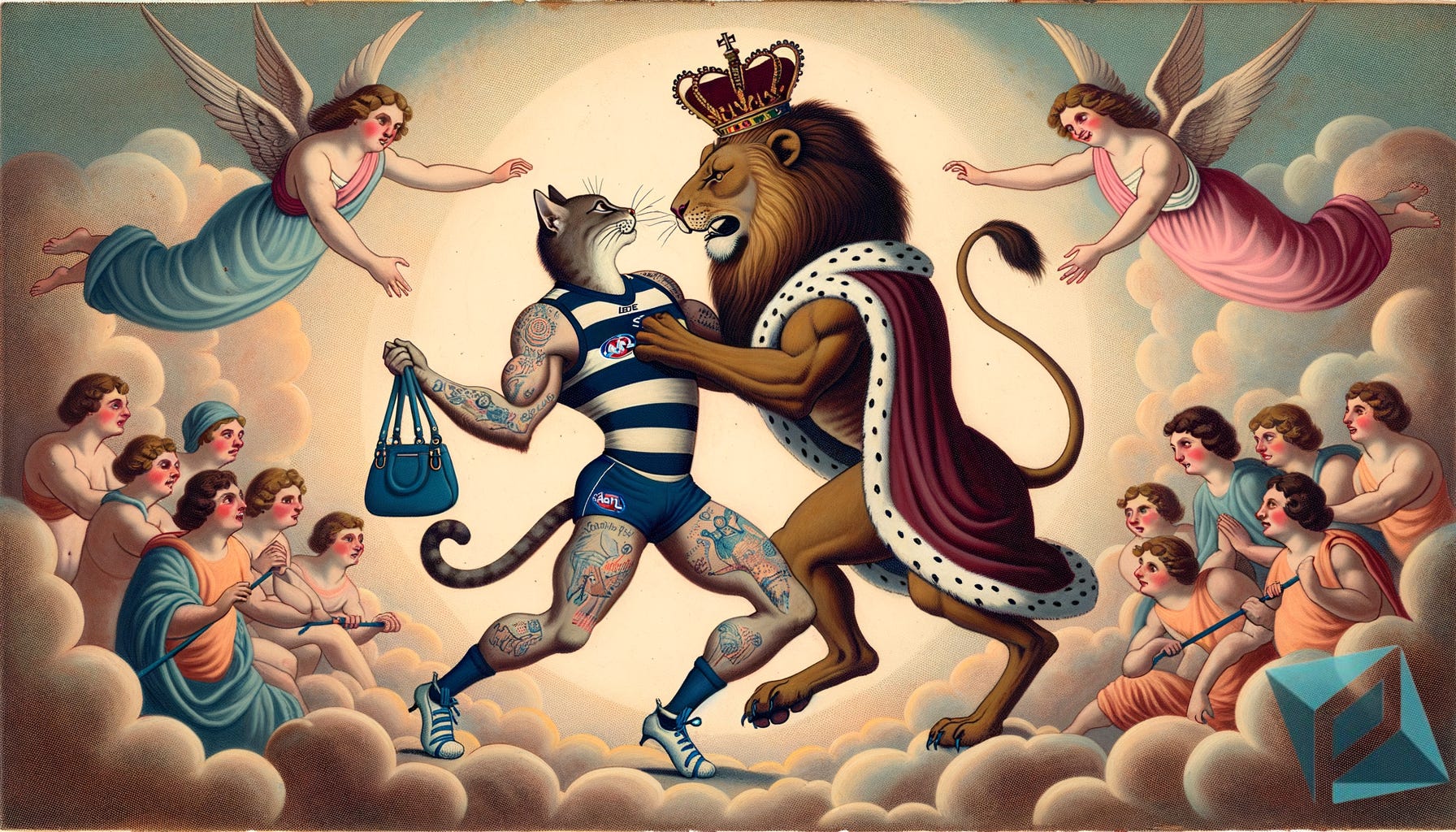
When Your Mortal Enemies Face Off Without You
For Hawthorn supporters, this weekend’s Grand Final presents the ultimate conflicted viewing experience.
Decades of rivalry with both Geelong and Brisbane have created deep emotional responses that go beyond normal fandom.
The absence of the Hawks allows for reflection on the complex history between these three proud, powerful clubs.
When Julius Caesar famously proclaimed “Veni, vidi, vici” (I came, I saw, I conquered), he described a swift, decisive victory. This weekend, my battle cry is more modest: “Videbo, Felix, Vici” (I will watch, The cats, One conquered). My mighty Hawthorn Hawks won’t participate in this Grand Final clash, but I will watch one great feline team—either Geelong’s Cats or Brisbane’s Lions—reach footballing greatness.
This weekend, as I prepare to watch the Grand Final between Geelong and Brisbane, I find myself in an awkward position. Both teams represent long-standing rivals to my beloved Hawks. So I’m faced with a tough choice: which of my two historical enemies would I least mind seeing win the premiership?
Era shapers
Between these three clubs exists a remarkable dominance in the 21st century. Since 2000, 15 teams have played in a grand final, but these three clubs have collectively won 11 premierships (Hawthorn (4), Geelong (4), and Brisbane (3)). Their combined 16 Grand Final appearances in this period further emphasise how these three clubs have shaped the modern era of Australian football, forming a tripartite hegemony that has defined excellence for an entire generation of football followers.
While Sydney and Collingwood have also been formidable forces during this era, the Swans making six grand finals and the Magpies five, my feelings toward them never developed the same visceral intensity. Perhaps it’s because neither consistently crushed Hawthorn’s premiership dreams in the way Geelong did, or perhaps the universal hatred of Collingwood is so universal that it feels ordinary rather than personal. It’s the Cats and Lions who occupy that special place in a Hawks supporter’s emotional spectrum, somewhere between grudging respect and sports-induced trauma.
A House Divided
The Hawthorn-Geelong rivalry has been played since birth. My mum hails from Geelong, so she supports the Cats, while my father barracked for the Hawks. Having a Catholic and a Methodist marry may have been contentious in the 70s, but not as much as this union. As kids, we fell in line—boys Hawks, girls Cats. The lounge room and patio viewing sessions formed the backdrop of my football education, especially in a non-AFL town of Sydney. Rivalries become part of our personal stories.
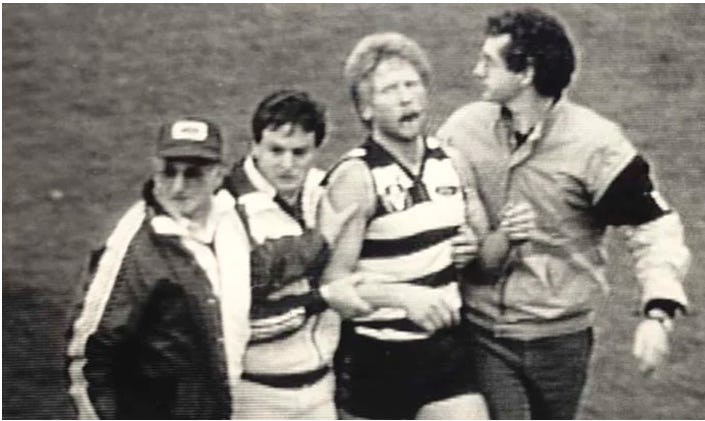
I was pretty young and living overseas at the time, but a defining moment in the rivalry was in 1985. In a wild game, “Lethal Leigh” Matthews punched Geelong player Neville Bruns behind the play and broke his jaw. Steve “Buddha” Hocking exacted revenge and broke Matthew’s nose, and it was on for young and old. For the first and only time in the history of the code, he was charged with assault for an on-field incident and convicted, but subsequently overturned. It was tough for Matthews to explain it to the coach, who was still a policeman.
The Battle of ‘89
A defining moment in the rivalry was the 1989 Grand Final. It’s widely considered the greatest premiership decider in VFL/AFL history. The brutal physicality of that match captured everything the rivalry represented: skill, courage, determination, and a refusal to yield.
Dermott Brereton’s courage after being blindsided at the opening bounce by a cowardly Mark Yeates, Gary Ablett Snr’s nine-goal masterclass in defeat, and the sheer intensity throughout created a reference point for all future encounters. The Hawks won by just six points, but both clubs had participated in something extraordinary. It is a match that became a legend.
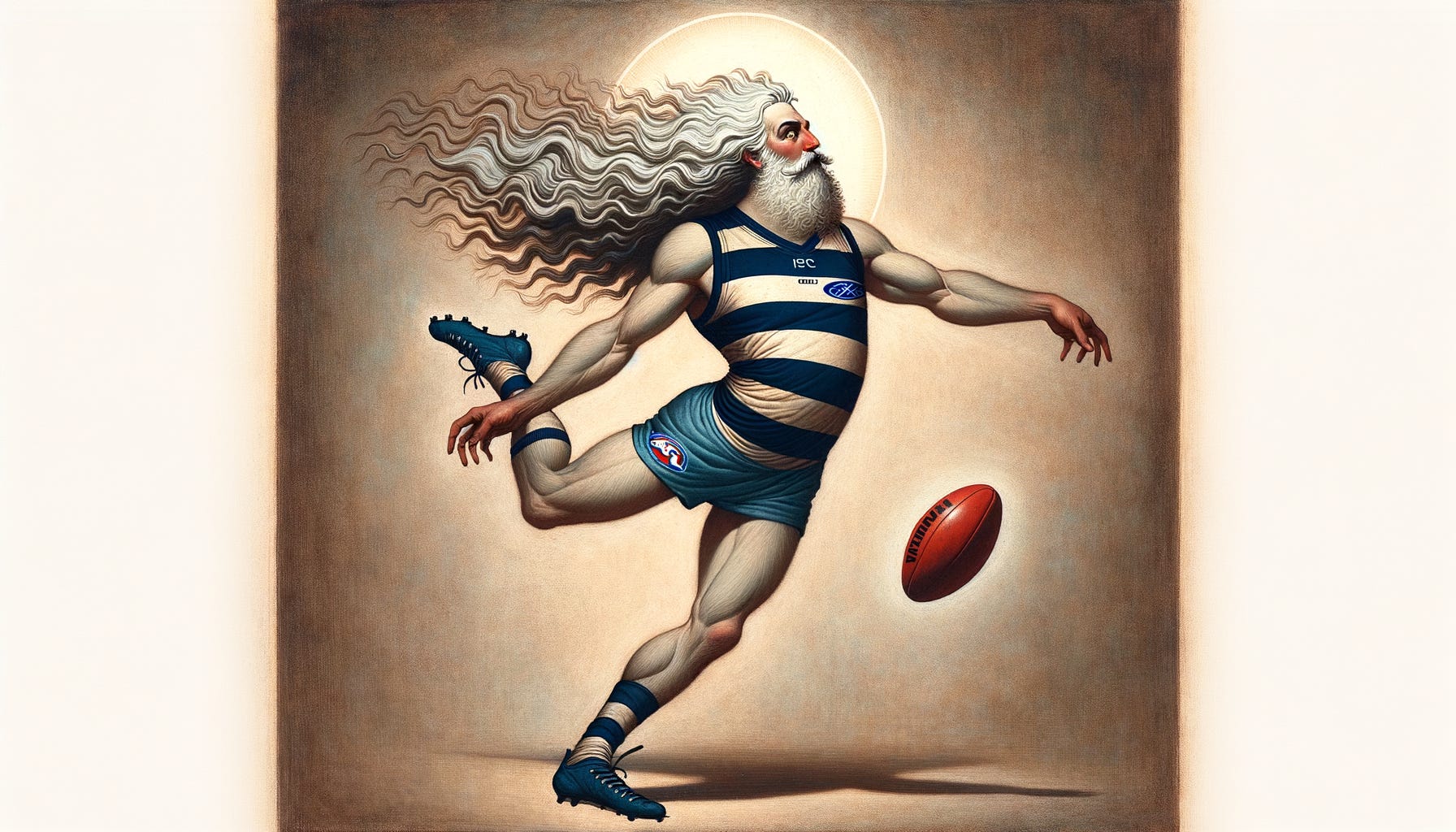
The irony wasn’t lost on Hawks fans that Ablett Sr., who tormented us that day, might never have been a Cat at all. Hawthorn had him on their list briefly in 1982 before letting him go to Geelong—a decision that would haunt the Hawks for years as he developed into “God.” One can only imagine how different football history might have been if we’d kept him in the brown and gold.
Kennett’s Curse
Hawthorn’s dominance lasted only one more season before a horror stretch of more than 15 years in the wilderness. The arrival of Clarkson and some exceptional draft picks in 2004 helped us rebuild. It led to the 2008 Grand Final. That year, the Cats had lost only one game all season, but we won a stunning 26-point win. Hodge, Rioli and a pudgy Dew played out of their skin, and Crawford won a grand final after 305 games.
After Hawthorn’s 2008 Grand Final victory over Geelong at the MCG, Hawks president Jeff Kennett suggested the Cats lacked the “mental drive” to defeat Hawthorn in important matches. What followed was extraordinary. Geelong defeated Hawthorn in their next 11 consecutive encounters, often in heartbreaking fashion. The statistical unlikelihood of such a streak against a similar quality team made supernatural explanations tempting.
The curse became a showcase for Geelong’s greatest talents to inflict maximum pain on Hawthorn supporters. Gary Ablett Sr. may have retired, but his shadow loomed large as his son, Gary Jr., systematically dismantled us during the early years of the curse. Tom Hawkins evolved from a promising youngster to a tormentor for the Hawks. Garry “Buddha” Hocking, Joel Selwood, and Billy Brownless all personified the Cats’ psychological edge. The 2013 preliminary final loss that finally broke the curse felt like escaping a nightmare that had featured an ensemble cast of Geelong champions, each with their own signature method of breaking Hawthorn hearts.
Each loss reinforced the curse’s power, with the Cats finding increasingly creative ways to break Hawthorn hearts. Last-minute goals, unlikely comebacks, and brilliant performances became normal in these games. The Easter Monday games in 2010, 2011, 2012, and 2013, when we were more than 30 points ahead, were especially hard to watch, especially live at the G in front of 60,000 to 75,000 spectators.
Last weekend, Patrick Dangerfield channelled that mindset, which is why he remains Geelong’s most dangerous weapon even at 35 years of age. His explosive play demonstrated that true champions find another gear precisely when their team needs it most. Bastard :)
The Lion King’s Transformation
In contrast, there was little to no rivalry between the Hawks and Lions before my move to Brisbane in late 1999. That’s when Kennet’s curse was replaced by Kirby’s curse. I could not have been more poorly timed for a Hawks supporter. I escaped the dominance of Sydney at the SCG only to witness the entire Lions dynasty up close and personal, often squirming uncomfortably in seats at the Gabba or Carrara.
What made these defeats particularly galling was watching former Hawk champion Leigh Matthews orchestrate them from the coaches’ box while his on-field generals executed with ruthless precision. Michael Voss embodied ruthlessness; Jonathan Brown tormented us. Jason Akermanis, with his bleached hair and boundless arrogance, saved special brilliance for Hawthorn match-ups. Alastair Lynch, in contrast, systematically dismantled our backline and was a diabolical goal kicker, each followed by a trademark understated celebration that somehow hurt more than any theatrics.
Few football experiences match the frustration of being a lone Hawk in a sea of Lions supporters during those years. The humidity and heat were exacerbated by steadfastly wearing my beanies and thick woollen #3 jersey at the Gabba. Few Lions supporters made the connection that their coaching mastermind, Leigh Matthews, terrorised opponents in those same digits when playing for the Hawks.
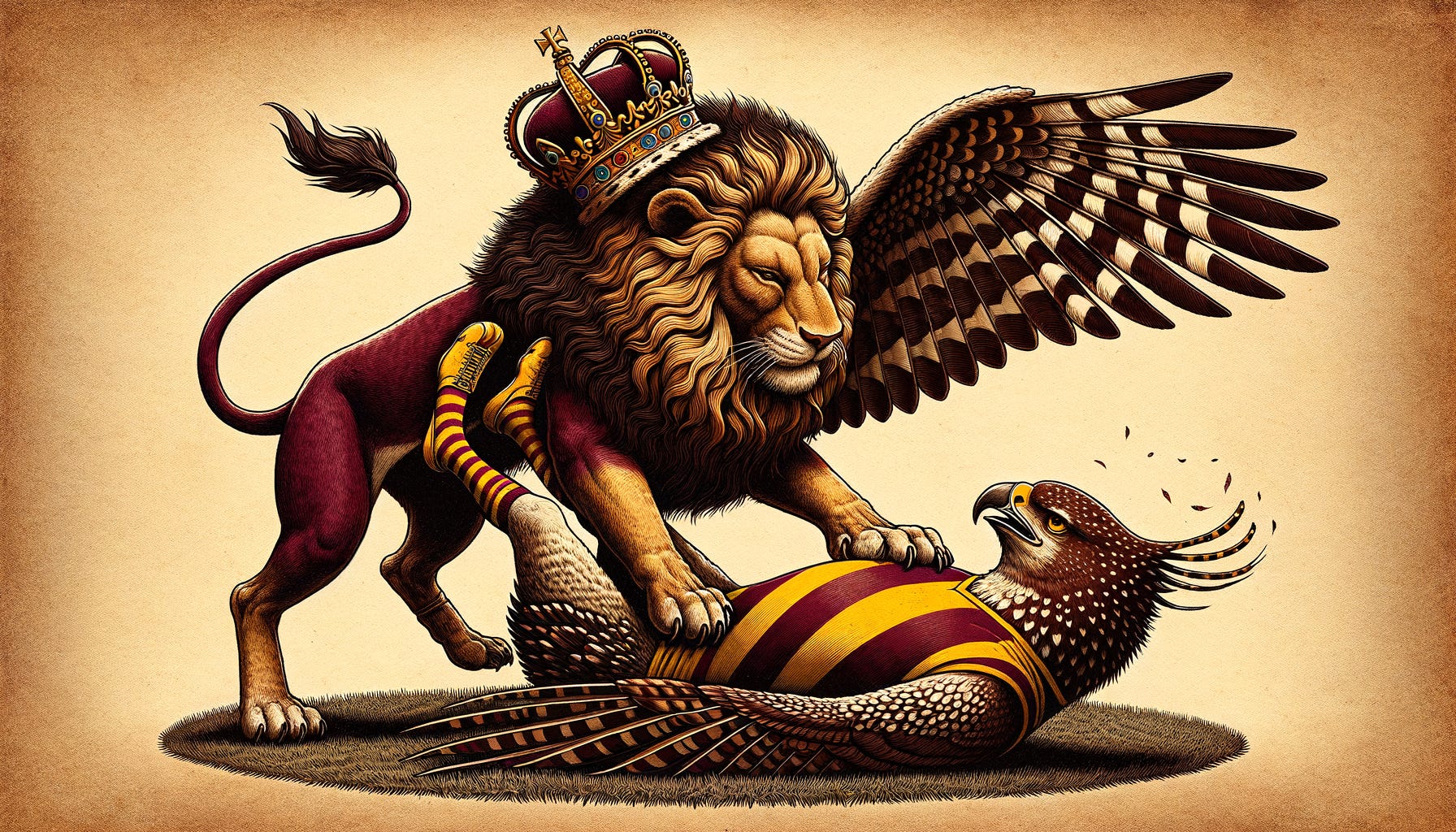
The Lions’ three-peat of premierships in 2001-2003 echoed Hawthorn’s dominance in the late 1980s, making their achievements both impressive and irritating. I still wince remembering certain matches where the Hawks were thumped. Losing Gabba games by 87, 102, 12, 48, 41, 10, and 25 points between 2001 and 2007 was hard. It had my now-wife wondering about my intelligence and questioning her decision to date me. Being convinced we’d win in 2006 and being left scoreless at quarter time was particularly painful.
I left Brisbane in 2007 and moved to Melbourne. Hawthorn played their last game in Queensland for a decade in 2008. Hawthorn won. This has haunted me for years. I’ve often wondered if the AFL started a team in Hong Kong, whether we would lose here, too.
This Weekend’s Dilemma
As Saturday approaches, I find myself in an unusual position, having no clear team to support. Both outcomes offer a mix of discomfort and grudging respect. A Geelong victory means enduring Mum’s triumphant phone call, while a Brisbane win resurrects memories of those Queensland nightmares.
Perhaps the best approach is to appreciate the contest for what it is—the season finale of the world’s greatest game, played at its highest level. After all, in a few months, the 2026 season will begin, and Hawthorn will have fresh opportunities to create new chapters in these storied rivalries. For now, I’ll watch with mixed emotions as my team’s two historical nemeses battle for supremacy, finding comfort in knowing that at least one of them must lose.
Great thoughts on international expansion https://open.substack.com/pub/javana/p/the-afls-2026-international-expansion?r=5h1r4j&utm_campaign=post&utm_medium=web